
What to Consider When Choosing a Fireplace
So you have decided to add a fireplace to your home. Now comes the tough part: choosing a fireplace that is right for you.
You will have no shortage of options, from sizes to aesthetics to the all important choice of wood-burning or gas.
Here are a few tips to help ensure that you get the fireplace that best fits your home.

Wood-Burning vs. Gas Fireplaces
The classic picture of a fireplace remains a wood-burning one. That’s why most gas fireplaces are made-up to look like wood-burning ones. For reasons such as convenience, however, gas fireplaces have become increasingly popular over the years.
Here are some areas to consider:
Ambience
Let’s face it, if you are opting for a wood fireplace, a large part of the reason is probably the experience. The crackle of the wood, the smell.
Maybe you had one growing up and loved the experience. Or maybe that magical enchantment of being curled up in front of a wood fire crackling on a cold winter’s night is something you’ve always dreamt of.
Modern gas fireplaces can provide an attractive look and do their best to appear visually like a wood burning fireplace. For those who long for that crackle and spark, however, it will always be a poor copy.
Convenience
When it comes to convenience, there isn’t much that beats gas fireplaces.
The fuel is piped into house. There is no cleanup afterward. Minimal ongoing maintenance is required. Many modern models you can even turn on with a remote control.
With wood-burning fireplaces, you have to ensure you keep a supply of firewood handy, build and light the fire and then clean up afterward.
Chimneys must also be regularly swept, and the exterior will likely require maintenance as well.
Efficiency
For as much as a wood-burning fireplace conjures up feelings of warmth in the imagination, in reality, gas fireplaces heat rooms more efficiently.
Some models can even allow you to control the strength of the fire based on the temperature of the room to keep it from getting too hot.
Wood doesn’t burn as cleanly and some of the heat vents up the chimney.
Cost of Operation
This is mixed and might depend on how much you use your fireplace. Natural gas is generally going to run slightly more expensive as a fuel than wood.
On the other hand, remember that there will be added maintenance costs with the wood-burning fireplace as well.
Choosing a Fireplace with the Right Aesthetics
If all you care about with your fireplace is function, your choice becomes a simple calculation of performance and cost.
Let’s face it, however, when it comes to picking out something that will likely be a focal point of the room, aesthetics matter.
Even if you aren’t trying to create a stunning visual feature, chances are you would prefer the fireplace at least complement the look of your home rather than obviously clashing with it.
Here are some aesthetic elements to consider when choosing a fireplace:
Color
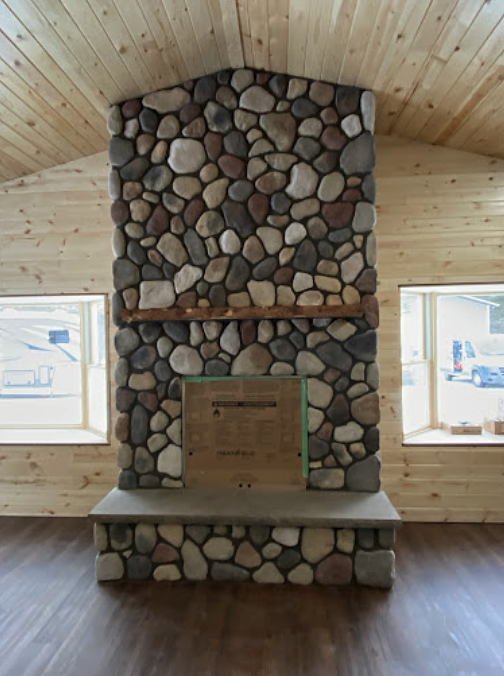
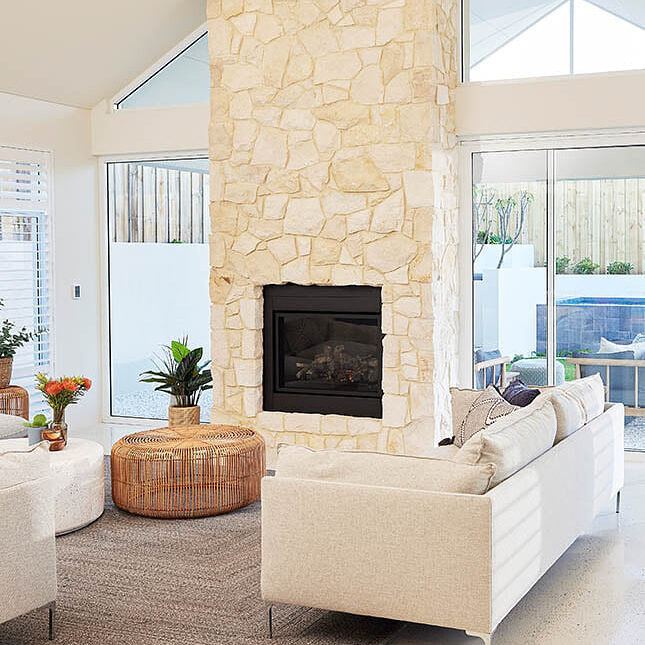
Brick or stonework or tiling surrounding a fireplace can come in a wide variety of colors, so it shouldn’t be too difficult to find one that complements the color of your decor.
Also keep in mind, if your fireplace addition is part of a complete room remodel, that you can work the other way as well. If you find a fireplace you adore, other furnishings can be selected to go with the fireplace.
Overall Feel
Ask yourself what is the overall look of your home. Then pick a fireplace design that makes sense with that look.
No matter how great they look separately, plopping a fireplace that looks like it was plucked from a cozy cabin in the woods into an ultra-modern looking house probably isn’t going to end up working well.
If your home reflects your taste, you’ll probably naturally choose something that complements it anyway, but this is still something to consider.
Picking a Location for Your New Fireplace

There are three major considerations you must take into account when choosing a location for your new fireplace:
1. Venting
In most cases, where you place your fireplace is going to be determined in large part by one thing: venting.
All wood-burning fireplaces and most gas-burning fireplaces require venting. It is why chimneys exist.
If you have a chimney, the most convenient way is to install the fireplace to vent through it. Otherwise you must take alternative venting measures to remove the fumes produced from your home.
2. Gas Lines
This is a little easier, but remember that if you have a gas fireplace you will need a gas line running to it.
Unless you are replacing a previous gas fireplace in the same location, some measure of gas line will likely need to be installed. How much, and how convenient it will be to run the line, could have an impact on the cost of the project.
3. Safety
A fireplace functionally takes up more space in your room than size of the portion that contains the, well, fire.
That is in part because of safety concerns. Even in a gas fireplace, where there are no embers, the heat produced alone creates the need for a buffer zone around the fireplace.
Make sure you leave room for these things in your calculations. If you are installing a wood-burning fireplace that requires a hearth, make sure there is space to put the hearth.
Contact Alliance with Any Fireplace Questions in the Duluth Area
At Alliance Inc., we know fireplaces. We not only install and maintain the fireplaces but also sweep and repair chimneys. We can even build you a brand new chimney. Because of our knowledge of every part of the operation, we can ensure that no detail is overlooked.
Because of our masonry skill with brick and stone, we can also work with you to design a custom fireplace that will both be functional and match the look and feel of your home. Contact us today for more information.